

“What is truth?” - Pontius Pilate
It was a pleasure to speak with Substack’s Avuncular Agnostic the other day. The opening salvo was made by me on his post about how Christians should not be condescending in our dealings with atheists and agnostics, and in particular we should never insinuate that the agnostic is subconsciously resisting God, rather than honestly trying to figure out the truth, as they believe themselves to be.
On the bus home after beers with friends, I wrote a comment on his post, which was, shall we say, vigorous. The final sentence of it read: “it is not epistemic humility to pretend that you are unsure about that which is obvious to you. That’s lying!”
Now my friend the Avuncular Agnostic thought that I was accusing him of lying, saying that the existence of God is actually obvious to him and he just pretends otherwise. He was so moved by the boldness of this claim and my confidence in making it, that he wrote a whole post responding to me. And despite thinking I had made this ridiculous accusation of him, he was very polite and complimentary.
In fact, I meant that a believer would be inauthentic not to be a little condescending in conversations with unbelievers. Well, I commented on his new post and we had a nice chat.
I believe that agnostics are genuine. But I think that they are playing some role in perpetuating their agnosticism, even as they find themselves to be earnest seekers after truth. Something about their way of truth-seeking has the effect of producing agnosticism. How is an honest agnostic truly to approach the elusive certainty?
This is my letter to Avuncular Agnostic, but before I begin, I have some requests to make, since I have put a lot of thought and love into this letter, and it really is my best effort at explaining how one can believe in God.
Please do not approach this letter in a spirit of evaluation.
Please resist the urge to make point-by-point refutations of the things I say. Some of my points are more poetry than anything. I believe that they contain truth, but if you approach them as if they were logically rigorous arguments, they will fall and you will fail to apprehend the truth. A worldview is like a house, and it is good for a house to have windows. But these windows are made of glass, and so they are the weakest part of the house. If you are evaluating the sturdiness of a house, you might find it useful to hit some of the wooden beams with a hammer, to see how they reverberate and such. But if you hit the glass with a hammer it will break easily. Different modes of communication require different postures of reception.
I request you apprehend the structure as a whole first before taking it apart. Let it wash over you. Be credulous. Inhabit my worldview as fully as you can.
I stand by most of what I said to you before, and I will briefly expand on it.
The medium is the message, and the message of infinite discussion and debate is agnosticism.
We tend to assume that discussion and debate will, in the long run, lead to a better general understanding of truth. Opposing perspectives will challenge and hone each other. Either we will approach an evermore perfect synthesis of the two, or if one of the two options simply is the truth, this will become clear over time.
I reject this, and submit that this process will tend to create a more perfect uncertainty. As evidence, I present our American society, which has operated under these pro-rational-discourse assumptions for pretty much its whole existence, and seems always to be pretty much evenly split into two camps which are increasingly in schism.
Why should this be so?
It is because we officially recognize only logic and reason as valid means for convincing someone of something. To be convinced through other means strikes us as a bit dirty or dubious.
The problem is, if we only recognize logic itself as valid, we may have no way to put p and not-p in conversation. Logic is great for deducing things from principles. But it has nothing to say about which principles are true in the first place. And there’s always a first place, you can’t get away from it. So a lot of these debates turn out to be the process of honing in on the actual pre-rational and opposed axioms of the two debaters. Whereupon they will have to, you know, agree to disagree. The best you can hope for in a debate is identifying the precise character of the disagreement.
Gödel proved almost a hundred years ago that in any formal system you would have an infinite amount of propositions which were true and yet unprovable. You would think this seismic discovery would have caused some kind of a stir and rendered “rationalism” permanently untenable, but since we are dealing with irrational axioms here, I guess the rationalists managed to find some kind of workaround, whereby the obvious conclusion of Gödel is allowed to be inconclusive. And now Gödel’s proof and its obvious implications will just be one move in the chess opening preparation metaphor you’re so fond of. But, if you think about it, of course those who are motivated, for various reasons, not to believe the obvious consequences of Gödel’s proof are going to think of something to say! And of course some of these guys are going to be pretty smart!
We can use certain axioms to deduce things. If A and not-B, then C. But you can't always use logic to resolve A versus not-A. If you were trying to convince someone to believe A, you couldn’t demonstrate it to them logically, because A is your first principle. So what would you end up saying? You could say — You should believe A because it’s good! But this is not considered valid argumentation. It's not sound. It's not recognized. It just wouldn't hold up in the court of logic. Or you could say — You should believe A, it’s beautiful. Or you could even say — You should believe A because it’s true! But again, none of these are arguments. And if your interlocutor is only going to recognize arguments alone as a valid contribution to the discourse, then there will be an impasse between you on the matter of A — which is the crux of everything which follows! So the whole chess game will just be a waste of time. At the end of it, one party may dominate the other, but the opposition of white and black will be exactly as it was when the game began, with no communication between them.
Many agnostics seem to demand their God-talk in the form of arguments. You say,
“What’s your argument? I’m very open to hearing it.” And indeed you are open to hearing it! But no matter how open you may be to hearing the other’s arguments, if it’s only arguments you’re interested in hearing, then you have taken a particular pre-rational position which will lead you to certain conclusions, namely agnosticism!
Anything one could say in justification or praise of A would be rhetoric. It is rhetoric that sways, that changes hearts and minds, that weaves us together into a shared life. But we don’t trust rhetoric.
Even small things like “whether fetuses count as babies” represent an insurmountable impasse without rhetoric. It is rhetoric which says “come on, they’re obviously babies.” Anti-abortion people say a fetus is just a baby that is in the womb. Pro-abortion people say that a fetus isn’t a baby, it’s a fetus. In fact, a fetus is objectively a baby, but defining a term is inevitably sort of arbitrary: it is a choice to give a name.
Reductionism attempts to override this subtle business by trying to make everything into an objective statement: I believe that such-and-such particles in the sky produce a so-and-so effect on a healthy human eye. But this is only an illusion of rigour, and now we are not talking at all about the sort of belief that one might have or not have in God. God cannot be reduced to this kind of thing. Even to say “I believe there is an eternal being” or something, you now have to define your terms. And eternity is a mystery! So the definition cannot really be rigorous or complete. Thus while it is completely valid to say “I believe in love,” the statement is incoherent from the perspective of belief as credence in propositions.
The dominance of dialectic and the absence of rhetoric produces an impasse. Logic alone can simply not get to the bottom of these things, by its very nature. It just cannot, any more than it can answer the question of “do I love this person, do I want to marry her?” I can tell you from experience that going back and forth and weighing the arguments and being scrupulously fair is quite fruitless in these cases. You never seem to get any more sure in either direction. You can never attain certainty from within that frame.
As a matter of fact, here is an argument.
Suppose you heard an argument for the existence of God that you found extremely intuitively convincing, and you couldn’t poke any holes in it. Like a really well-presented version of the fine-tuning argument that seemed to answer all your counter-objections. And you were pretty convinced by it. But you are too reasonable, and too aware of how much in the philosophical literature you are ignorant of, to let this one moment overwhelm you! After all, there are many people much smarter than you on both sides of the debate, and the fine-tuning argument is hardly the last word in the discussion, but only the opening premise on one side of 20+ moves of chess opening theory, which must go on the board before the game can even begin! So you are obliged, your duty to the truth, to seek out the best response to this argument, and the response to the response, and so on. The original argument, which so moved you for a moment (and perhaps was never truly answered), is nonetheless integrated into the general rhythm of your agnostic explorations. The system reaches equilibrium; you return to being only 50.01% sure that God exists. You could never let yourself have a dramatic moment of conversion, because you know there are so many arguments, so many smart people believing so many things.
Now, the ideal would be that through iterating on this process many times, engaging honestly, finding arguments convincing, trying to acquaint yourself with all the responses to the responses, and so on — that you would slowly make progress and approach an answer.
And certainly this is how it goes for some people, this is kind of how it went for me. But there is certainly a way that we can evaluate whether or not this is actually happening. We can simply check whether or not your explorations of these topics have so far led you in any direction, or whether you have stayed around 50%. If you were around 50% when you started reading a lot of arguments for and against God’s existence, and you are still around 50% — well, I know that you are 50.01%, and maybe you used to be at 50, so maybe that’s something. Maybe I can help you get to 52 or 53, and if this is how it’s going to go, then glory to God.
But if we believe that engaging with these arguments is going to point us in the direction of the truth, we should expect to see some kind of direction. If we do not, this is evidence for my thesis that after a certain point, engaging with more arguments only keeps us in a state of agnosticism.
And so, we came to the question: “if rational dialectic is not going to convince me that God exists, what can?”
How to Believe in God?
Well, first of all, why should we want to believe in God? Well, we should want to believe in God if there is a God, and we should want to disbelieve in God if there is not. Since we care about truth.
But there is surely some kind of Pascal’s wager thing here, because we stand to miss out on a lot more in the former case than in the latter. Let me explain. If we believe in God, and follow the Christian religion, and there turns out not to be a God, then we are limiting ourselves for no reason. We are introducing unnecessary difficulty into our relationships with gay family members. We are depriving ourselves of the innocent joys of premarital sex. We are wasting thousands of cumulative hours over our lifetime at Church. We are forever thwarting our search for truth by getting bogged down in the honeytrap of institutional religion. We are living for something outside the world, when the world is all there is: we are living inefficiently.
But if we do not believe in God or follow the Christian religion, and then it turns out that there is a God, I can show that we are limiting ourselves far more severely. In this case, there is a transcendent, all-powerful being of pure love, who created us and wants to be in relationship with us. In the memorable analogy of Dr. Zac Porcu, we are like a power strip plugged into itself. To believe in God and to abide in Him, to get right with Him, is like plugging out of ourselves and plugging into the wall. It is, in a word, to be actually alive. God is the wall, the source of all reality and energy. He also has rules which He would like us to follow for our optimum flourishing, and He is the foremost authority on that subject. He also has a plan for our lives, and everything is under His control, so we don’t have to worry about so much. If we are indifferent to His rules and His plan, we are going to be living really suboptimally. Maybe not in every area, but surely in some areas. Also there’s an evil fallen and corrupting spirit who has become fully estranged from reality itself and is hell-bent on getting you to embrace the same state. The problem with the power strip analogy is that a power strip is either plugged into itself, the wall, or nothing at all. But we can become more and more self-plugged. Or more wall-plugged. Communion with God, being itself, is an asymptote. Alienation from God, nothingness itself, is also an asymptote. If you’re not careful, the devil may be able to use your habitual selfishness to coax you into a more self-plugged state, and you don’t want to build any momentum in that direction, lest you awake one day and find yourself twisted into a wretched parody of yourself.

It was this sort of thinking that actually got me into spirituality in the first place. I was lonely on my university campus. I wanted a girlfriend and I wanted a group of friends. I knew that there were people out there whom I would really like and who would like me, and on my atheist worldview it seemed like it was up to me to find such people, by searching through the available options. But so many options! So many people to meet and places to go. If you were trying to evaluate as many options as possible, you would be constantly cold approaching people, moving from place to place, and swiping on tinder, but then you would sacrifice depth. So I got to thinking, suppose there is some kind of general guiding force, some kind of fate/destiny thing, whatever makes synchronicities happen. Whether or not such a thing exists, it’s better to believe it does, because otherwise I’ll be tormented by this existential FOMO of all the infinite options. And even if it doesn’t exist, then at least I won’t have wasted a bunch of time fretting. This “faith” in existence to arrive in good time, rather than me having to create it from raw data in the marketplace, was the first faith I came to, and you can see that it is decidedly Pascalian.
So, either way, if we are wrong about the basic foundation of reality, we are gonna be worrying about some things that don’t matter, and neglecting some opportunities to live to the fullest. But we are far further off, and we miss out on so much more, and live so much worse, in the case of being deluded towards disbelieving in God, if He does exist. If God doesn’t exist, and we are deluded towards believing in Him, all that really happened is that we acted a bit silly. Which, being a bunch of little apes, we were probably going to do anyway. Plus, Christians seem not to be much hamstrung by this egregious error of theirs, it certainly doesn’t stop them from making huge contributions to philosophy and science, serving in public office, raising a family, or making great art.
So, it is clearly much worse to be wrong about the question of God’s existence if He does, in fact, exist. And thus Pascal’s wager is sound even before considering the question of an afterlife.
But there’s more. It was hard to write the above paragraphs, because the notion of there not being a God is so utterly ridiculous to me now that I can hardly even suggest it is a possibility. This wasn’t always the case: it is the fruit of faith. Faith is a gift. If we can lean in even a little bit, God is reaching out to us and will love on us big time. He gives us faith, and then if we lean in a little more, we get more faith. Less one dramatic leap of faith than many leaps, each a step on a long journey: like Kierkegaard’s Knight of Faith, we must “transform the leap of faith into a gait.” But you abide in God and He will reveal himself. A little at a time. It’s not that God is being stingy with Himself, but that you need to open yourself first.
And the reverse is manifestly not true of atheism. If you commit to the atheist position, perhaps you can get to a place where you’re thinking about God less. But I don’t think you ever get more convinced of atheism than in that moment of deciding to commit. Some atheists, like the infamous New ones, do find theism ridiculous, but only because they are very ignorant about it. I have never met an informed and curious person who thought this way. But me and all my friends do find atheism ridiculous, and we are reasonably well-informed, I should think.
Thus atheism must be agnosticism, indefinitely, since you are genuinely a seeker of truth. But Christianity only gets further and further from agnosticism, since it is a journey with a real direction. So there is an asymmetry here. In fact everything about it is asymmetrical. And that is why Pascal’s wager is about much more than just the infinite utility value of Heaven.
You don’t believe in God so that you can go to Heaven:
You go to Heaven so that you can believe in God!
Stop being so scrupulously fair to both sides! You’re not neutral, I’m sure you’d prefer a transcendently good creator to exist. No, stop, I already see you reaching for the problem of evil. We are talking about the possible existence of something so good that it would answer the problem of evil in completely satisfactory fashion if you were only to catch a glimpse of it! It would render all your reckonings on that subject irrelevant.
I don’t deny that the problem of evil appears to be a very difficult matter from our present perspective, I don’t say that you should just forget about it. But if God is real, everything will make sense, and be ok. Do you not prefer this option? Do you want God to be real?
When a Christian cites a passage like “Trust in the Lord with all your heart, and lean not on your own understanding,” or 1 Cor 2:14, I think, well, don’t I need my own understanding or discernment to figure out what those thoughts even mean? Wouldn’t any theological truth you have to share be expressed in language which would then require me to use reason and understanding?
And there’s the corollary question of if it takes more than reason to believe something, why wouldn’t I believe just anything? I think Sagan’s example was the invisible dragon in the garage, but pick what you will. My understanding of faith/pisteu is that it was kind of a legal term, used to explain the sense of being convinced by evidence of something, even though you didn’t see the thing itself. But again, I don’t know how you get this faith without the reason evaluating the evidence. (Avuncular Agnostic)
It seems like there’s sort of two ways to think about belief that are both equally wrong. One says belief is simply holding credence in a proposition as objectively real. The other says belief is an arbitrary choice we make based on our preferences. Thus, we might say, you have your beliefs and I have mine, and they’re only beliefs. I saw a woman saying to an Orthodox priest, of the latter’s anti-abortion activism, “sir, I know you have a religious belief that this is a life that is being lost. But that is just a belief.” Now the trouble with this way of thinking is pretty obvious: to believe something is to think it is the truth.
The trouble with the other way of thinking is more important for our purposes, and is far the trickier, but I think I can say something about it anyway. It has something to do with words and their definitions. Language is a living thing.
The Latin fides has more of a legal connotation than the Greek πιστεύω or the Hebrew הֶאֱמִין. None of them refer to having high credence in a proposition.
In the Hebrew, this verb הֶאֱמִין - he’emin (related to amen) has connotations of leaning on something, relying on it. The Greek πιστεύω - pisteuo is similar. It has to do with trusting another person, having a bond with them. It is about commitment. Abraham abided in God and was rewarded. You wouldn’t abide in the invisible dragon which you just made up.
So the sense in which we believe in God is closest to the sense in which you say to another person “I believe in you.”
When you say to someone “I believe in you,” you are not just saying that they have x talents which qualify them to have a high likelihood of achieving x task. If that is what I mean, then I have no role in the matter. There needn’t be an “I” to believe it. But in the universe and in reality there actually is an I and a thou, and the possibility of true communication between us, not just detached observations. This is why believing in God is not like believing in any other premise.
The matter hinges on posture more than reason. How, from what posture, are we receiving reality?
Reality is relational! We are not detached transcendent observers. We are not critics, scientists, or spectators of reality. We are not judge, jury, or executioner of reality. A posture of detached evaluation is bound to produce agnosticism.
We must reframe. We must feel ourselves to be full participants in reality. On theism, we are the image of God; on naturalism, we are the apotheosis of evolution. We know that existence is a fractal thing, so whatever is the answer to the question of “why is there something rather than nothing,” it ought to be reflected most clearly in us! We are in the game! We are not scientists looking at arguments. We are not unbiased observers. We are in! We are reality itself!
There is no one outside of the matter doing the choosing, evaluating, weighing. Faith is participatory. Abiding in, being directed towards.
So, to reiterate, no, you can’t just choose to believe in God. Nor can you just reason yourself into it. You need to live towards God.
If I were to make a list of the things that you should do in order to maximize your chances of believing in God, I would put at the top that you should really, really want to believe in God. Whatever amount you currently want to believe in God, you should thank God for it (truly it is a blessing; He has not abandoned you if you still desire Him) — yes, thank him for every little blessing, every tiny moment of certainty, every crumb of desire for Him or gratitude for reality — cherish these! Treasure them, keep them close, and cultivate them. They are your seeds. Indeed: that you still seek God is itself His presence in your life. He is with you in your doubt!
Don’t get me wrong. It’s good to be rationally convinced. Frankly, I was rationally convinced a lot easier than you, so I cannot speak flippantly. What you’re going through is hard. I know you don’t want to believe anything false. You don’t want to delude yourself. You are humble, and you know that many people much smarter than you have certainly deluded themselves, and you want to be careful.
But the fear of deluding yourself causes procrastination. I once procrastinated a long time, not wanting to break up with my girlfriend or marry her, not wanting to make a mistake. I wanted to know God’s will for a fact. But this sort of procrastination approaches an asymptote where the actual choice becomes impossible, it seems infinitely far away. The uncertainty feeds on itself, and the thing just feels impossible. And it’s terrible, because the more the uncertainty dominated me, the more I craved and idolized certainty.
Certainty is a gift, and it is a fruit of a certain approach to reality. You make the leap of faith, and then you can be sure, after. But it’s a subtle business: the leap itself is not totally blind. It’s just a matter of approaching reality faithfully.
We have to have some kind of faith, even to live. For instance, I can’t prove that solipsism isn’t true. There is no logical evidence for the existence of others. Yet, I believe it. And then, once I believe it, I can know it for a fact. The same is true of God.
Isn’t it obvious that your son and wife are real? But what arguments can be mustered in support of this notion? There may be people much “smarter” than you, in philosophy departments and elsewhere, who are committed solipsists, who have made arguments in favour of this view — but are these people not fools? Why give them so much credit and attention just because they are “smart”? What is smartness for, anyway?
Of course you can see your wife and son, but that’s not why you believe in their existence. You would still be able to see them if they were mere automatons or hallucination. Their minds/souls are the thing you believe in, and you can’t see those.
It’s the same with God, for me. I can’t see him, and I can’t prove that He exists. But it’s obvious that He exists.
To believe in God is to attain to this kind of knowing, like your faith in the existence of your loved ones, which is pre-rational and transcends reason.
Can you imagine how awesome it is to believe in God, to be as certain that He exists as you now are certain that your loved ones have minds just like you? Dude, it’s the best. Everything becomes so much easier and better. You actually become way smarter from it, because everything else sort of falls into place around it. It’s absolutely electric. I can’t recommend it highly enough.
But how to get there? Let me stick with solipsism for a moment. Suppose you were completely agnostic over the question of others’ existence. And you were always turning it around in your head and reading philosophical arguments about it, trying to familiarize yourself with the literature.
This would not be the most efficient way to get clear on the fact that others exist. The best and most efficient way, by far, would be to spend a lot of time with others! Make more friends and gaze into their eyes. Joke around with people and allow yourself to be surprised. Go fishing with your son. Play catch. Have sex with your wife and be fully present, and gaze into her eyes. Take up jiu-jitsu and wrestle with a bunch of random people. Learn another language so you can talk to people from different countries. Ask old people about their lives.
Without a shadow of a doubt, at some point in this process you will realize, wait a second, I completely believe that this guy is real!
So, with God, it’s the same. Get in touch with Him. Pray, and go to church.1 Walk the walk. Read the lives of the saints instead of philosophical arguments. Reread C.S. Lewis. Start with the Space Trilogy, it’s just so much fun.
I would advise you not to meet the question of God’s existence too head-on.
Focusing on it too much is a little like trying really hard to go to sleep. You have to get into a kind of flow state in order to get in touch with God.
A tree root which meets a big rock grows around the rock. The root grows and becomes a major artery. After years and years it has completely encompassed the rock. It’s a similar case with these sorts of things. Grow around this stumbling block.
I think the most important thing you can do here is cultivate a more holistic vision of things. Iain McGilchrist is a good theoretical foundation for this with his left brain/right brain hypothesis. My friend Simon just read his book “The Master and his Emissary,” and it comes highly recommended. It turns out that we modern people are excessively left-brained, we break everything up into chunks and look past the higher order. That’s why we can’t draw. We look at a face and see eyes, nose, mouth. Whereas a more integrated person would look at a face and see a face! Therefore, try to become right-brained: see things as a whole! Look into stuff like Sheldrake’s morphic resonance and the evidence for it. Come to believe that everything is connected, in some vague and mysterious way. I frankly took the shortcut to this by doing lots of psychedelics starting at the age of 17, and eating weed edibles about 4 days a week for several years. But there are many ways to attain to a natural mysticism.
I really like the Lewis quote that says, First let us make the younger generation good pagans, and then let us make them Christian. That would be my advice to you as well. Try and make yourself a good pagan. Try and understand what is right about paganism. Spend some time with pagan philosophy and a general spiritual sort of worldview. I really like some Hindu writings about God. Sadhana: The Realization of Life by Rabindranath Tagore is a favourite of mine, just the first chapter is enough. Also Autobiography of a Yogi by Paramahansa Yogananda is a fun read and a real credulity-stretcher. Perspectives like these will reveal to you the possibility that God’s existence might be obvious quite apart from the question of Christianity. Try becoming convinced that materialism is untrue. What is your nature as a human being? What is going on with evolution? Sometimes it’s good to step away from the God question and look into some of these other things. I started believing in God partly through psychedelics, but also through evolutionary psychology and quantum mechanics and random other courses of study that wouldn’t seem to have any connection to God.
Then I became a bit of a vague pantheist monist for a while. And that worked really well for me. I never had to weigh atheism and Christianity. These two are so far apart I don’t see how they can communicate much. It’s hard to weigh them. But at one time in my life, about five years ago, I was actively weighing reductionist materialism with some mysterious “other” model.
In this season, I was in great uncertainty. I know how it feels. Is there something divine, or is it just atoms and the void? This was my question. I was trying to figure out if there is something going on at all. And I just went to California and I saw humpback whales. And I had sex and I did drugs. And then I just felt like God was real and like I was religious somehow. And I started to feel religious.
Primitive human society believes in animism, the idea that everything is alive and has a spirit. Now, from a skeptical perspective, you could say, “well, what does it mean for everything to have a spirit? What are these terms? Is it just semantics to say that everything has a spirit, does that just mean that everything is being what it is, or does it imply that everything has a consciousness?”
The skeptical point of view is not neutral. It has its own agenda. It will always make this move of saying, “well, what does that even mean? What is a spirit?” And thus you are demanding for things to be strictly defined, which is not a neutral position, it’s a very specific set of assumptions. And I would argue you’re missing out on the whole point of language.
Let me demonstrate this more concretely. What would you respond if I were to ask — earnestly seeking a logically complete definition — “who are you?”
You will note that it would be entirely inadequate simply to say your name. Your name has no logical content; considered merely logically, it is meaningless and arbitrary (nothing could be further from the truth. . .) Nor could you list off your characteristics and interests, since they could never be complete, and none of them represent the core of who you are. To speak of your relationships — I am from here, I am the son of x, the father of y, and the husband of z, and so on — would be closer, but still would not satisfy my desire for a precise and rigorous definition! There is really nothing you could say to define yourself to me.
Yet I would not then be entitled to deny you existence on the basis of your inability to define yourself, and it would only be slightly more reasonable to be agnostic about your existence. You are evident to me in other ways than by explaining yourself. It would be obstinate of me to demand you present yourself in this specific way. Now, of course the reason why we might demand this of spiritual entities like God, is that we cannot see them. But this suggests there are only two ways to know something: to see it, and to define it logically — and this is only marginally less absurd than to suppose there is only one way.
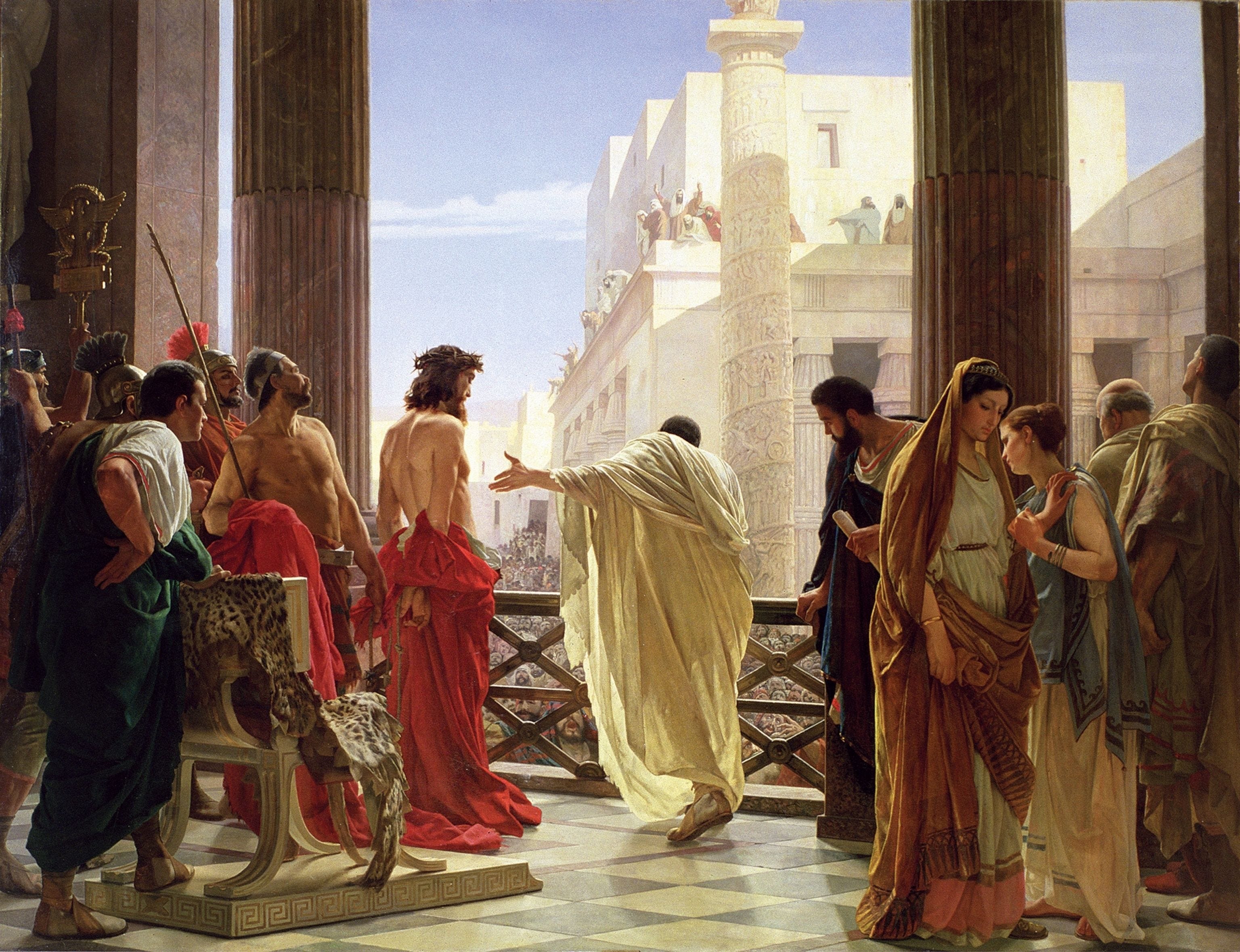
“What is truth?” Pilate asked of the Truth. He received no answer—received none because his question was in vain. The living Answer stood before him, but Pilate did not see in the Truth its truthfulness. (Florensky)
What could Christ say that would satisfy him? There is nothing. Pilate knew this, and he left the room immediately after uttering his banal rhetorical question. The Truth cannot be defined in a logically complete and rigorous way. Truly his question was in vain.
I have to be honest and say that in my life, some degree of skepticism (there is a golden mean, I think) has always amplified my faith. Because the truth of Christianity always comes as a bit of a surprise. It still is an enormous surprise, which I am still reeling in the wake of.
So if I am open to the possibility of being wrong about the singularity of Christianity, it becomes even more amazing when I read about the history of the Church and how completely this thing upended and transformed all the assumptions and created morality as we know it by asserting the dignity of the human person qua person, and that all of European history since then has really been an extension of Church history, a people’s theology being its guiding object and thus defining its destiny.
Or if in the back of my mind I harbour doubts about the doctrine of the Trinity, thinking that it seems a bit arbitrary, and perhaps was some kind of a corruption of the message and person of Jesus, then I am all the more pleased to find that the men who named the doctrine of the Trinity came by it so honestly, and they were among the most righteous and brilliant people in the history of the world: exactly commensurate with the notion that God specifically created and called these men at this time for this grand purpose of coming to understand His nature a bit better, on behalf of all humanity.
Of course none of these things are silver bullets: if I were completely skeptical, I could always find alternative explanations. The guys who made the Nicene Creed were just really smart guys swept up in an all-too-exciting thought experiment; the good works of their lives were a result of that same Smartness. The Christian Church simply was the release of a pressure valve in the culture of Rome, and a lot of built up resentment towards the dehumanization of the current order, along with longing for a better life, just happened to be released, given voice through the invocation of Christ, this great idea.
So you certainly have to be in some real openness to and relationship with Truth for even skepticism to be productive. “Lord, I believe; help my unbelief.” If I were you, I would make this prayer my breath.
Pray unceasingly. This is what we are told to do, and it is possible. I find myself saying “Lord have mercy” all the time these days, it is my breath. These are the sweetest words in any language to me. As long as they are on my lips I am in perfect peace.
This morning I woke up very early, which is unlike me. I felt like I should get up and pray. So I kneeled outside for a few minutes. Then I wanted to go back to bed because I felt a little tired. I was unsure whether to go back to sleep, or get an early and powerful start to the day. I went back to bed and closed my eyes, but I was full of morning energy now, and felt a little guilty to be back in bed, and knew there was no chance of my falling back asleep anytime soon. So I got up for good, and even though I still felt tired, I knew this was the only one of the two options that I could actually commit to.
My recommendation: Orthodox Church.
Thanks for the response. As requested, I have no notes, nor will have any for some time.
The way you use writing to call and awaken the heart is refreshing.
I find it quite brilliant that you use language to point away from itself, not just in the content but also in the form of your writing. Your words take a doxological shape, which you invite the reader to participate in through the prefatory terms you laid out.
Coincidentally, I’ve also been meditating on the limitations of logical reasoning recently although in a more technical form of writing. You might like my short reflection on the epistemic futility of man without God in this eschatological world, given we are participants not critics, and therefore never see things as they are (except through revelation that works through our faith): https://jamieday.substack.com/p/eschatological-ontology
I don’t mean in this to advocate for a crude fideism or misology, but to emphasize that good arguments come from good faith given that the nature of reality is beyond us.
That said I will not apologize too much for being hard on reason. Wonder and beauty and desire and innocent faith get too bad a rap, especially since as you allude to, we all have skin in the game. It’s about time we mock the mockers; it’s not like discursive argumentation will move them.
Partial truths can look so wonderfully coherent! Whole truths can look so utterly strange.
Reality truly is stranger than fiction.
I suppose the one person with the authority to adopt the spirit of the critic is God. The rest of us should have a spirit of wonder.
I think our Lord Jesus Christ is referring to something like all of this when he said the following:
“The eye is the lamp of the body. So, if your eye is healthy, your whole body will be full of light, but if your eye is bad, your whole body will be full of darkness. If then the light in you is darkness, how great is the darkness!”
- Matthew 6:22-23
I love that Christianity presents a way of escape from the darkness. That is what the gospel is — the fullness of God’s revelation to the world, not just through insight (psychedelics seems to help with that piece as you attest), but further through complete bodily communication. God stands at the door and knocks, offering a way out of the box, or rather enters into the box, transforming our very being, renewing us at the pre-axiomatic level, inspiring our faith by grace so that we are illumined, so that we may learn to believe in God.
Glory be to Jesus Christ!