
Against Gifted Programs in General
Idolatry of smartness makes everyone dumber

Norm has a good joke.
It’s always supposed to be for the people from the future, you know. That’s how they try to trick you.
They always go: The Children are the future, which is true. But! They said that when I was a child! Then I grew up, I was like “here I am!!” and they’re like “ah, now it’s the other kids.” Ah, you—…I had a feeling there was somethin here…I know a Ponzi scheme when I see one…”now it’s the other children.”
Zohran Mamdani was in the news recently for wanting to end a “gifted” program in New York which separates the wheat from the chaff as early as kindergarten.
This was controversial, although the alternative is to do the exact same thing come grade 3.
I would like to argue that the whole gifted kid thing is counterproductive, and we would be better off without it. It stems from an idolatry of smartness which makes everyone stupider.
Just look at all the “former gifted kids” who experience “gifted kid burnout.” It’s even been elevated to the status of a “syndrome”!

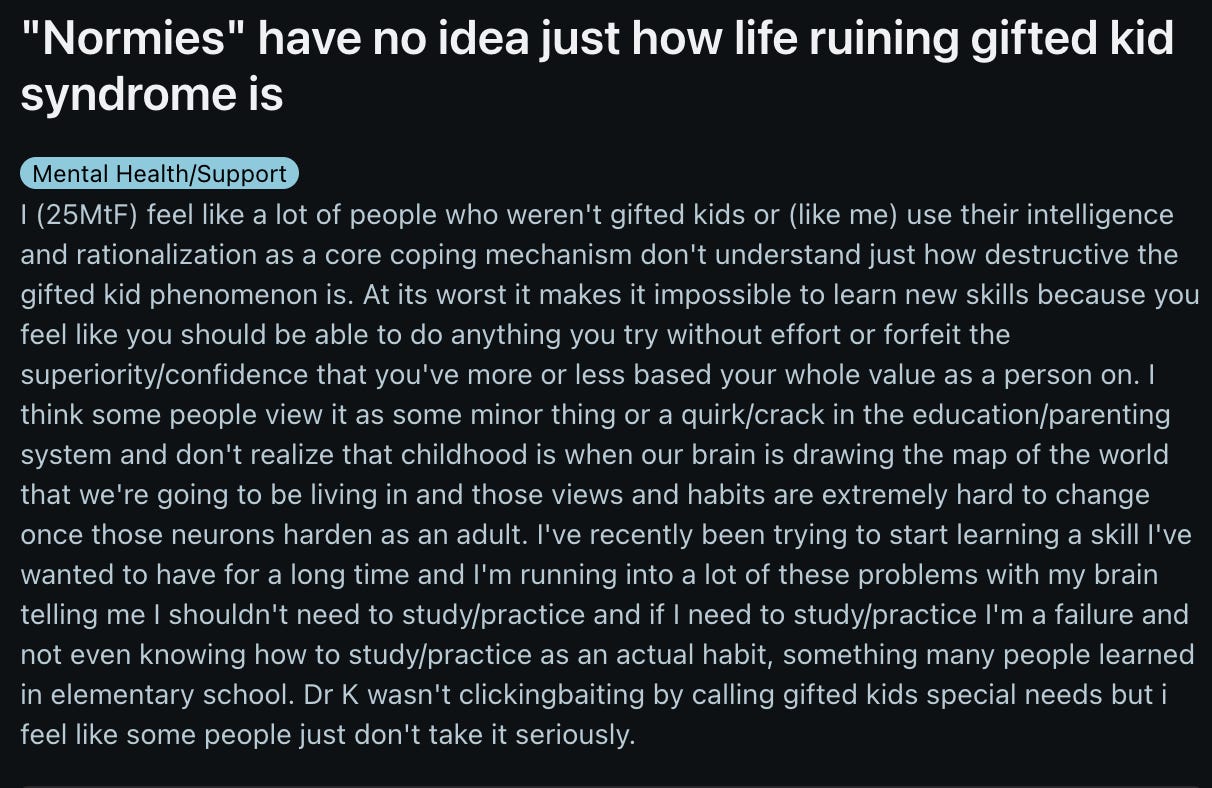
Mainly what happens with gifted programs is that these kids learn to identify themselves with their (ostentible) relative superiority to the other children. It becomes a load-bearing pillar for them psychologically. (Even more so if they have trouble socially, a superiority complex being a potent coping mechanism.)
But that’s not all. In our culture, we idolize smartness. And we also idolize potential. So the gifted kid, with their high potential for instrumental reason, is made into an idol by the adults around them. This is made clear to the child by the language the adults use. They speak in absolutes. So it’s not just a relative superiority over the other children. It is also, for a secular child, essentially the Mandate of Heaven. That is, the whole social system, and all figures of authority, have identified the child with (essentially) infinite potential. Great Man Theory of History went out of vogue for a few decades, but it was always alive and well among those parents with bright 6-year-olds, and the school administrators who would love nothing more than to have greatness on their hands, to mould.
The child is the future, life and light and hope for a better world.
This is not the way to develop smartness! Because to develop anything good requires humility. And to get all this intense narrative energy poured over you and your infinite potential will make you prideful. To be made an idol, from such a young age, by the entirety of your social world, by all respected authorities, is obviously going to make you retarded.
There is a deep Christian yearning in secular society, to be saved by the perfect child. There’s a reason why Christmas is so much bigger than Easter. Partly because of consumerism, yes, but I think partly because we basically still believe in the Nativity, while having entirely lost faith in the Resurrection. The golden child of destiny to be born to save the world—this mythic pattern is alive and well in a very fallen and idolatrous form.
And the symptoms of this are visible everywhere. It is impossible to understand the psychology of Silicon Valley, for example, without grokking that these boys were all the chosen one, the most Gifted and special boy in the world. The idolatry of their smartness is at the very centre of their self-concept, to this day. Altman, Bankman, Yudkowsky. If you know about these guys, then you know what I mean.
So even in the ostensible success stories, where the gifted kid really does realize their tremendous potential, they are forever skewed towards pride and grand narratives, forever easily bought by praise or myth. Just look at the proliferation of rationalist cults.
The flagship of which is the “AI doomers,” led by one Eliezer Yudkowsky. He’s the guy who popularized “AI is going to kill everyone.” The spiritual refrain behind all these guys is articulated well by Qiaochu Yuan here:
Eliezer’s fantasy for how this was gonna go was clearly explained in harry potter and the methods of rationality - a single uber-genius, either him or someone else he was gonna find, figuring out AI safety on their own, completely within the comfort of their gigantic brain, because he doesn’t trust other people.
“Harry Potter and the Methods of Rationality” is Yudkowsky’s 600,000 word Harry Potter fanfiction ably roasted here by Sam Kriss, able roaster.
The text belongs to a particular sub-genre called self-insert fanfic, in which you rewrite an existing work with yourself as the protagonist…The main character of HPMOR is called Harry Potter, but—and the author has been very open about this—in fact he’s a stand-in for Eliezer Yudkowsky. The original character’s personality consists of a vague, milky goodness and bravery. This Harry, meanwhile, is fantastically annoying, and also a sociopath. He is constantly pointing out logical fallacies and namedropping scientific concepts. When he first witnesses magic in action, this is what he says: ‘You turned into a cat! A small cat! You violated Conservation of Energy! That’s not just an arbitrary rule, it’s implied by the form of the quantum Hamiltonian! Rejecting it destroys unitarity and then you get FTL signalling!’ (People who know more about physics than me tell me that while all the scientific concepts in the text exist, they seem to have been peppered in essentially at random.) He also, for reasons that aren’t entirely clear, immediately starts using his knowledge of social psychology to blackmail and manipulate everyone he encounters, and belittles everyone he considers stupider than he is. I guess that’s just what incredibly smart people do…
Throughout the story, whenever Harry encounters something that offends him, Yudkowsky describes him being overcome by a sudden cold fury, colder than Antarctica, colder than the depths of space, in which everything is seen with perfect icy clarity and every fibre in his body is primed to exercise his will. Every single time, he then proceeds to have what can only be described as a spluttering, spastic tantrum. In his first Potions lesson with Professor Snape (and I am not happy to be typing these words), Snape makes a few sarky comments, which prompts Harry to accuse him of being abusive, threaten to start a media campaign to have him fired, say things like ‘I decline to recognise your authority as a teacher and I will not serve any detention you give,’ physically threaten him, try to storm out through a locked door, and then hide in a cupboard. After a few of these displays, Harry quickly becomes the coolest kid at Hogwarts. All the other students, and the teachers too, are utterly awed by him. With his powers of knowing about social psychology and logical fallacies, he is something like a god. But everyone is also slightly scared of him. To be fair, some character development does take place: by the end, Harry has learned how to not be so frightening, and how to use his powers of effortless domination more strategically. There is a general failure of self-awareness here I have not seen outside Sonichu. It makes for genuinely harrowing reading.
Of course, a lot of amateur fiction does the same thing: you invent fictional people to fawn over you when real people fall short. What makes HPMOR unusual is that real fawners then followed. For a lot of rationalists, this book was their way into the subculture…
Despite being genuinely horrible, this story does have one important use: it makes sense out of the rationalist fixation on the danger of a superhuman AI. According to HPMOR, raw intelligence gives you direct power over other people; a recursively self-improving artificial general intelligence is just our name for the theoretical point where infinite intelligence transforms into infinite power. (In a sense, all forms of instrumental reason, since Francis Bacon in the sixteenth century, have been oriented around the AI singularity.) This is why rationalists think a sufficiently advanced computer will be able to persuade absolutely anyone to do anything it wants, extinguish humanity with a single command, or directly transform the physical universe through sheer processing power….I think the big nonexistent robot at the centre of the ideology explains a lot of other aspects of rationalism. The structural unreality that seeps into everything they believe.
The “big nonexistent robot” and things like it will always be irresistible to gifted boys who are now men and did manage to get smarter in spite of being incredibly prideful (there may be some horseshoe-theory thing at play where the very most prideful actually become as diligently self-improving as the genuinely humble) and are desperate to be at the centre of a story, to be Harry Potter. Saving the world from a hypothetical computer will apparently suffice. Just anything to get to be the Harry Potter chosen one, at long last. But not the chosen one, per se, because that implies some kind of higher power to do the choosing. To be the chosen one in a materialist cosmos can only refer to Raw Smartness, which is Infinite Potential.
Infinite Potential: you’d love to have it.

I know exactly why these “former gifted kids” have trouble becoming competent human beings, and why they tend to take refuge in dramatic mythos, in lieu of full participation in immediate reality.
It is because: as an idol of infinite potential, you can’t get any larger.
In order to become larger, in order to become useful, you are obliged to collapse that idol of infinite potential. And that’s a hell of a thing to give up, especially if it’s so central to your identity. But if you don’t give it up, it will simply slip away, and you will slowly become only a very mediocre adult.
Pride dooms one to stagnate on a plateau, sooner or later. Pride is always a stagnant thing, I think by definition.
If you’re humble, then you have a chance. But the flip side of the “gifted program” problem is that the kids who aren’t categorized as particularly gifted are often neglected. They get a kind of internalized inferiority complex. Neither group is equipped with the psychological tools to grow into their fullest selves.
Clearly there’s nothing wrong with giving talented youngsters support, mentorship, and challenge. And the bigger problem here is grouping kids by age in the first place, and the industrial school system in the actual first place. Still, I hope I’ve persuaded you that sorting the children according to their estimated potential is based on an insidious idolatry of intelligence which impedes the realization of that very potential.
Excellent! I agree that the gifted designation probably harms people in the long run, but I wonder if there’s a way to instil humility in these gifted kids while also keeping their busy minds active and fulfilled in class so they’re not bored all the time. I guess they could just read quietly.
Your main thesis about the idolatry of intelligence was spot on. Someone I know and love is exactly like this, his traumatic brain injury got him subconsciously worried about losing his intelligence so he doubled down on everything, refused to acknowledge that it was a gift, from grace, and it could be taken away. It is so unhealthy when it’s your whole identity and it’s threatened either by wasted potential or brain damage. Leads to the worship of IQ, eugenics, feelings of superiority and entitlement etc — some traits the rats/adjacent subcultures tend to be guilty of. But our whole society is structured around intellect, striving to get into best universities to find the best job, and I do believe it is a good thing to cultivate—maybe that’s the key difference, seeing it not as innate talent but something to work on but not idolize
There’s a lot of good stuff here, but it feels a bit fragmented. Two key notes that could be expanded a bit more are the myth of progress, which always locates paradise in the future, as oppressed to acknowledging it has already come to us now, in anticipation, in the Liturgy (see my friend Fr. John Strickland’s recent podcasts—well, and all his books, really—for more on that!); and the child-saviour complex which, as you note, is being transferred to AI (see my own recent takedown of that: https://geekorthodox.substack.com/p/the-internet-education-ai-and-the).
On the core question, I don’t know if I’d oppose gifted programs in general. I think your closing comment about our industrial model of educating children in age-related cohorts is closer to the source of the problem. (Here, Sir Ken Robinson’s classic talk on the subject is seminal: https://www.ted.com/talks/sir_ken_robinson_changing_education_paradigms) A lot depends, though, on the nature of the program being implemented. I do think sorting and streaming children as early as Kindergarten is clearly a bad idea. And removing the opportunity for children gifted in some area to help out their less-gifted peers would have robbed me of one of the key experiences that convinced me (after helping my fellow student in Computer Science class) to become a teacher. But some enrichment to prevent talented students from getting bored in class is probably a good idea: I still remember listening to The Hobbit in Grade 7 with some of the other “good students”, and independently studying about The Charge of the Light Brigade from an enrichment centre in the same class. (My Grade 6/7 teacher, Dave Shields, was awesome!)