
Against Crypto
put ur money where ur mouth is

Should I buy Bitcoin? Will it give me infinite money? — Something you were given to think about, from time to time. The expected value is clearly very high: possess bitcoin, watch it become infinite money, mint your spot in the permanent overclass. . . It’s eschatological, it’s Pascal’s wager. Every once in a while you would meet a true believer. They had made money from crypto, or were hoping to, and they would evangelize to you. Perhaps you hemmed and hawed, then acted convinced; you gave them a good return on their energy. Yet you never bought it; you stayed agnostic. Why?
Believing in bitcoin and buying it were two sides of the same coin. Unity of betting and voting: perfect money-mouth convergence: the future of markets, gambling, and democracy. 2070: Polymarket attains absolute dominance over the whole gambling industry — sports betting, stock market, casinos, oh and “the news” — and comes to prop up and weld to the U.S. government. What an interesting, what a symbolically rich period of history it shall be! Elections become wagers: you bet on your candidate, and your bet is your vote, and you get paid out based on the odds if your guy wins. Is this not the logical conclusion of democracy/capitalism? Should you not PUT UR MONEY WHERE UR MOUTH IS?
Anyway, crypto’s claim to be the destiny of digital finance once seemed basically plausible, and you never looked that deeply into it, but it crossed your mind from time to time, that maybe you ought to buy it, to secure your shot at infinite money.
Crypto is now DEAD. But why? The conditions which bred the story are still in play. Fiat fades: we don’t trust the word of States. But crypto is no longer believable either. Nowadays, even the guys who did make money off crypto seem kinda lukewarm about it. Where once animatedly they would proselytize, now they only pay lip service. They’re buying gold and silver. The wave has passed. But why?
PROOF THAT, CONTRARY TO POPULAR BELIEF, BUYING A LOTTERY TICKET IS RATIONAL
Economics assumes that people are rational, will maximize expected value, but anyone can tell you that this axiom is false: people are not rational. However, I can tell you that people actually are rational after all! For example, buying a lottery ticket, believe it or not, does maximize expected value.
Suppose a lottery ticket costs $1. Now, for all intensive purposes, that is no money: an absolutely insignificant amount. And you are now in the running to win perhaps $1 MILLION: a famous amount of money, which is, in fact, infinite: at least in the moment of winning, or imagining winning it. The $1 which past-you earned and of which future-you will now be deprived is worth nearly nothing to present-you. But the dream of infinite money is worth quite a bit. So the optimal, rational value play is to buy the lottery ticket, but just one, and only once in your life. I haven’t bought mine yet, as I’m waiting for the right moment, when I will certainly win.
The general meaning of this wager, always identical with itself, is beyond doubt: it is worth exchanging a certain nothing for an uncertain Infinity, all the more so because in the latter the one making the exchange may receive his nothing back again, but now as something. (Florensky)
Bitcoin is the ultimate lottery ticket, but it is a bet on the direction of society, rather than pure chance. Each person who invests in bitcoin is betting, and also voting.
Bitcoin has lost its narrative momentum: partially because it proved pretty easy for the existing financial institutions to absorb it; also because people don’t want to pay for their coffee with one millionth of something: one mustn’t underestimate the value of aesthetic, especially for something like MONEY which is very deep indeed. . .
ON THE HISTORY AND NATURE OF MONEY
The origin of money is CREDIT : every coin is an IOU.
The classic story holds that money evolves from barter, which is the primordial form of economy, but it’s inefficient, and so we take to using some commodity, like beads, shells, or gold, to facilitate the existing market system.
The noted Satanist, Adam Smith, Jr., basically made this story up from first principles. He pulled it out of his bum. It turns out that barter is never the primary form of exchange, in any primal society, anywhere in the world.1
This is because barter is inefficient! — The very fact identified by Adam Smith Jr. But he concluded that because barter is so inefficient, it must have evolved into currency. In fact, because barter is inefficient, it is never practiced.
David Graeber wrote a funny thing about it:
Just about every economics textbook employed today sets out the problem the same way. Historically, they note, we know that there was a time when there was no money. What must it have been like? Well, let us imagine an economy something like today’s, except with no money. That would have been decidedly inconvenient! Surely, people must have invented money for the sake of efficiency.
Let me make my point about bitcoin and then we can get more into the history of barter some other time. Graeber does a good job in his book of demonstrating that there is nothing particularly primordial about barter; indeed, you usually see it when coinage-based market systems collapse!
The actual primordial economy consists of a network of interpersonal credit.2 Since everyone in the village knows everyone, you don’t need a universal medium of exchange: you just keep track of your credits and debts the same way you keep track of any other type of social data, like who gets along with whom. This is perfectly efficient, and certainly doesn’t call for the whole-cloth invention of a vast abstraction. You only need money for agricultural civilization, to keep track of exchange on a super-relational scale: you get writing around the same time and for the same reason.
But even when money does come on the scene, it does so as credit, long before coins. Sumerian temples have records of grain debts going back at least 5000 years.
(The storable, legible, and essentially fungible nature of grain makes it an exact parallel to money: it’s no accident money is referred to as “bread.”)
Then in 600 B.C. you have the first documented instance of state-issued coin-type money, in Lydia of Anatolia: electrum lumps stamped with the face of the King. Soldiers are paid in it, and taxes collected. Counterfeiters are executed.
(Now, you cannot counterfeit Bitcoin, which is to say that all Bitcoin is counterfeit: it just takes a lot of energy to create — “mine” — it. Mine, all mine. . .)
Coinage is fiat: the state guarantees its value. The King says: trust me, this will continue to hold value: by my strength, I swear it. It is his countenance, representing his promise, which confers value. The King asserts himself as the singular lodestar of society.
Belief in the state is what makes the coin worth something, much more than its gold or silver content.
Rome began to “debase” its currency in the first century under Nero, reducing the silver content significantly. But the denarius continued to hold value and be accepted for two whole centuries as the silver content was continually debased until by the end the coin was entirely copper with a thin silver sheen: the weight was all wrong, and the silver coating rubbed off on your hand. Still, people used the coin, on account of a great inertia of belief in the Roman promise and peace.
Christ Himself handled coins with Caesar’s face on them. They are rather like icons. He also handled the question of how to handle them.
Απόδοτε τὰ Καίσαρος Καίσαρι καὶ τὰ τοῦ θεοῦ τῷ θεῷ —
Return Caesar’s to Caesar and God’s to God. (Luke 20:25)
The word ἀποδοτε is usually translated as “render,” but it has explicit connotations of returning, fulfilling a duty, paying back what is owed.
Money is of the state: it is the state’s call to its citizens, and our obligation to respond. The Kingdom of Heaven, however, no more issues currency than does the tribe — for here we have direct, immediate relationship, requiring no abstract intermediary.
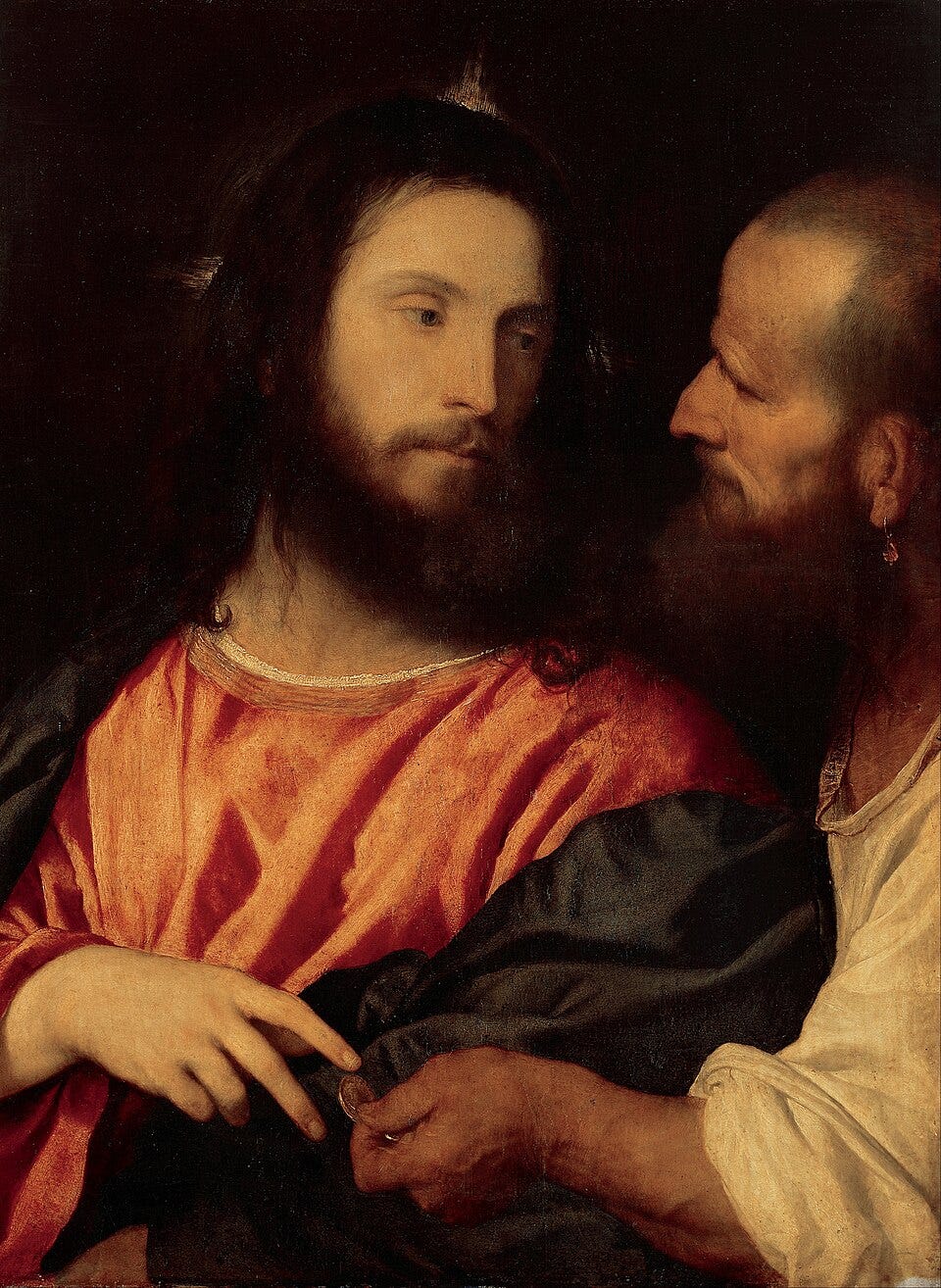
So the history of money is basically five thousand years of people saying “I owe you,” then the king stamps his face on metal and says: “I’m good for it.” In both stages, money is a promise.
When the U.S. government went off the gold standard, it was not the start of fiat, but more of a mask-off moment. The promise of the American good life, American progress and prosperity, had already been the foundation and scaffold of the global economy, because the U.S.A. is the great empire! You’d love to own U.S. dollars: a piece of the dream.
Bitcoin is, on the face of it, a response to the failure of this promise. In its heyday it was a great unifier. Anarchists and billionaires alike found allure in its ostensible techno-optimism, its libertarian aesthetic, the notion of “decentralization.” Bitcoin, it was thought, ought to be the great innovation that allows us to go without a state. The promise of Bitcoin is that it is the first non-fiat currency: no one has to make a promise. This is also the problem with Bitcoin.
MONEY IS A SPEECH-ACT
Money is best understood as a promise rather than a neutral medium of exchange or store of value.
Those Mesopotamian clay tablets are the earliest evidence we have of money, and they are acts of speech: I owe you.
To say that every coin is an “I owe you” is to say that it is an act of speech — and what a thing to say! I owe you, I contain what is yours, part of me belongs to you. A promise: crystallized, dehydrated, fired, hardened: speech set in stone.
Colin Gorrie writes: “Words meaning ‘to owe’ developed into abstract expressions of obligation so often that it’s useful to have a name for the phenomenon. I call it the owe-to-ought pipeline, named after one of the clearest cases of this development. The word ought is, in fact, nothing but the old past tense form of owe.”
Adam Smith Jr., the Satanist, was a professor of Ethics by profession. It was he who promulgated the doctrine that Economics should be its own discipline separate from Ethics and Politics: he invented it by severing. But in light of the true nature of money as representation of social bonds and obligations, what we OWE each other — the falseness of this separation becomes clear. (and it is from the same lie that we have now got the separation of the spheres of production and consumption, work and leisure — to our extreme spiritual detriment.)
“Capitalism” is the making legible, the quantifying of these deep and fundamental types of debt, the making of promises and giving of orders among fellows. Even mentorship and brotherhood are not too sacred to be run on the new operating system of cash exchange: everything can be quantified.
Rosenstock-Huessy understood that the life-blood of all society is speech:
the giving of roles: father, king, companion, apprentice
the calling by name
the giving of orders
the making of promises
orders and promises given and fulfilled: this is what we are talking about!!!
Bitcoin fails because no one is speaking. Wait — that’s not quite right: the guy evangelizing is speaking! He may even have said “just trust me bro”: he makes a promise! Interesting, he is ultimately central to this whole thing. . .
He speaks for bitcoin. Bitcoin itself is silent as the grave, speechless, nameless, and faceless: nobody speaks it into being. It is a mirage because nobody has put their identity behind it. Its creator is anonymous, he has nothing to say for himself.
Since Bitcoin itself says nothing, it is strictly meaning-less. Men speak for it and about it. The promise of promiselessness is made by no one: its form reflects its content: it is, like Hell, an absurdity: a self-definition of pure No-thing-ness.
Both pyramid scheme and ponzi scheme: there is nothing at the root, no lynchpin, no capstone. Only the evangelist.
Bitcoin fails because you cannot put your money where your mouth is: when you espouse crypto, your mouth’s location is: around your own tail. . . “that most unsatisfactory meal.” (Chesterton) It is a pyramid scheme, yes, but what does that term do? It offloads cognitive labour. Why is a pyramid scheme wrong? There is something dishonest about it: the speech is all a trap, it rests on nothing. The mouth of the scheme is the evangelist, let us say he is Me. I am a true believer because I am bought in; I bought in because I believed. I need you to believe me; I need you to buy in and confirm my own faith. If I convince you to believe my promise, I infect and saddle you with a lie, a millstone around your own jaw, demanding to be passed on, like one of those email chains where if you don’t pass it on you are going to be visited by a spooky ghost of some kind. The value play is clear: to avoid an event of infinite disutility, just get over yourself and your pride, and pass on the email, no matter how unlikely it is to be telling the truth.
How much Christian evangelism is like this? The linguist Everett went to convert the Pirahã people of the Brasilian Amazon, and lost his faith in the process, but did he actually have any to begin with? Or was he just trying to offload his debt of wrestling? Come to think of it, why do those poor Jehovah’s Witnesses sit outside all day with their pamphlets and their little science-fair booths? Oddly their doctrine is the exact opposite of a pyramid scheme: only 144,000 people can be saved, by recruiting you they actively diminish their own odds, but better a marginally higher risk of Hell than sit with doubt, face uncertainty. . . we certainly cannot judge them, we bitcoin-ambivalent gamblers. Was it through our own virtue that we stumbled into the true sacraments?
COUNT THE COST
Global Bitcoin “mining” consumes roughly 170,000 gigawatt hours of electricity per year, which is:
Comparable to the annual electricity use of the 46 million citizens of Argentina
8 times more than ChatGPT, 12 times more than Google, and 29 times more than Facebook
Enough to fuel all the world’s electric vehicles for two years
Each individual bitcoin mined costs over 200 megawatt-hours, roughly the energy consumption of an average American home for nineteen years: enough time to raise a first-world child to the age of majority.
We spend this to “produce” a bitcoin. What is the nature of the mining process? Well, as you may know, nothing is actually being produced. The crypto blockchain is based on “proof of work,” that is to say, wasting energy.
Every ten-odd minutes, a secret number (called a “nonce” — incidentally, British slang for pedophile) is randomly generated
such that when combined with the block’s data and run through a cryptographic hash function, the output starts with a certain number of zeros. The hash function (SHA-256) is a one-way function: you cannot work backwards from the desired output to find the input. The only method is brute force — guess a number, hash it, check the result, repeat. Billions of times per second, across millions of machines worldwide.
The difficulty automatically adjusts so that globally the right answer is found roughly every ten minutes, regardless of how much computing power is thrown at it. More miners means higher difficulty means more energy for the same ten-minute rhythm.
The “proof of work” is proof that you wasted electricity. That’s the entire security model. The chain is trustworthy because attacking it would require re-doing all that wasted electricity, which would cost more than any conceivable gain. Security purchased entirely through guaranteed waste. (Claude)
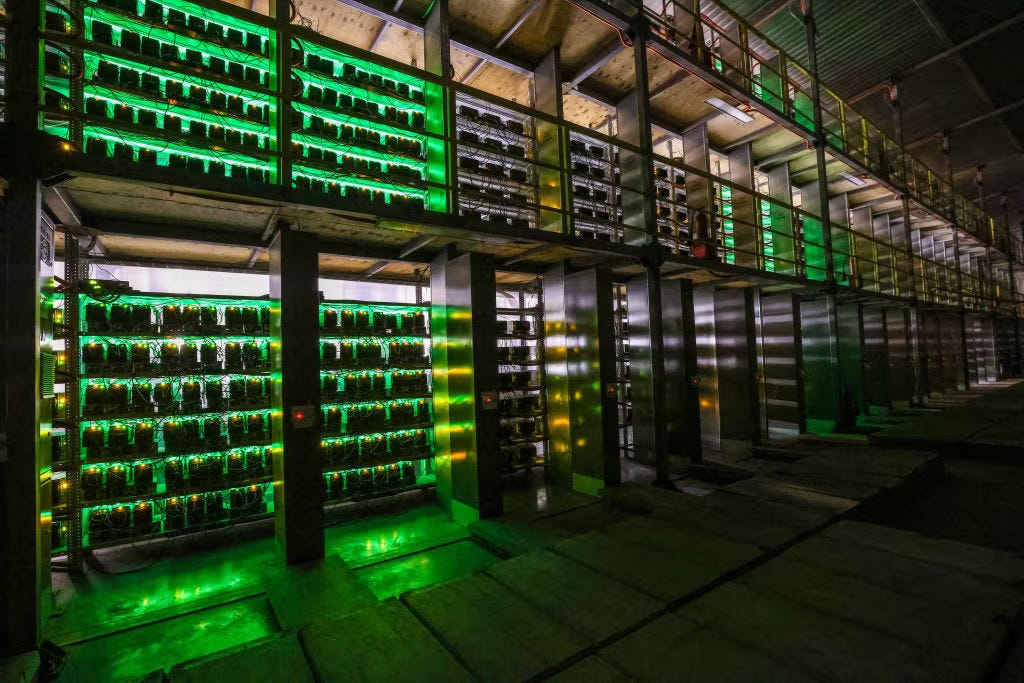

Now that we have put our finger on the nature of money-as-promise, as “I owe you/trust me,” we have a sense of what all this juice is paying for: it is a way to get around trusting anyone!
The cost of our present crisis of speech can be partially quantified by the energy we are wasting on Bitcoin.
Revealing the true inefficiency of modern workarounds: this is how much we have to waste in order to get away with not trusting each other, for now. THIS is the cost of our inhumanity!
Bitcoin was always something of an eschatological lottery, because its whole premise was predicated around becoming the new guy, that is to say, the post-state global currency, as good as gold. Either it becomes the guy, or it is meaningless and worthless, and is remembered as a shockingly self-incriminatory fad, the perfect beyond-satire symbol of our insane bankruptcy, and our descendants will say of it: “how did they ever buy this?”
The present polemic against Bitcoin is my own vote/bet: I do not think Bitcoin will succeed at becoming the guy; I suspect it will go to zero instead. And also, I oppose Bitcoin and I hope I am right. Our age’s dearth of speech cannot be merely worked around. Only new speech can breathe life into our weary machine.
“For centuries now, explorers have been trying to find this fabled land of barter — none with success. Adam Smith set his story in aboriginal North America (others preferred Africa or the Pacific). In Smith’s time, at least it could be said that reliable information on Native American economic systems was unavailable in Scottish libraries. But by mid-century, Lewis Henry Morgan’s descriptions of the Six Nations of the Iroquois, among others, were widely published — and they made clear that the main economic institution among the Iroquois nations were longhouses where most goods were stockpiled and then allocated by women’s councils, and no one ever traded arrowheads for slabs of meat. Economists simply ignored this information. Stanley Jevons, for example, who in 1871 wrote what has come to be considered the classic book on the origins of money, took his examples straight from Smith, with Indians swapping venison for elk and beaver hides, and made no use of actual descriptions of Indian life that made it clear that Smith had simply made this up. Around that same time, missionaries, adventurers, and colonial administrators were fanning out across the world, many bringing copies of Smith’s book with them, expecting to find the land of barter. None ever did. They discovered an almost endless variety of economic systems. But to this day, no one has been able to locate a part of the world where the ordinary mode of economic transaction between neighbors takes the form of “I’ll give you twenty chickens for that cow.” The definitive anthropological work on barter, by Caroline Humphrey, of Cambridge, could not be more definitive in its conclusions: “No example of a barter economy, pure and simple, has ever been described, let alone the emergence from it of money; all available ethnography suggests that there never has been such a thing.” Now, all this hardly means that barter does not exist — or even that it’s never practiced by the sort of people that Smith would refer to as “savages.” It just means that it’s almost never employed, as Smith imagined, between fellow villagers. Ordinarily, it takes place between strangers, even enemies.” — David Graeber, Debt: The First 5000 Years
“Say that Joshua were to give his shoes to Henry, and, rather than Henry owing him a favor, Henry promises him something of equivalent value. Henry gives Joshua an IOU. Joshua could wait for Henry to have something useful, and then redeem it. In that case Henry would rip up the IOU and the story would be over. But say Joshua were to pass the IOU on to a third party — Sheila — to whom he owes something else. He could tick it off against his debt to a fourth party, Lola — now Henry will owe that amount to her. Hence is money born. Because there’s no logical end to it. Say Sheila now wishes to acquire a pair of shoes from Edith; she can just hand Edith the IOU, and assure her that Henry is good for it. In principle, there’s no reason that the IOU could not continue circulating around town for years — provided people continue to have faith in Henry. In fact, if it goes on long enough, people might forget about the issuer entirely. Things like this do happen. The anthropologist Keith Hart once told me a story about his brother, who in the ‘50s was a British soldier stationed in Hong Kong. Soldiers used to pay their bar tabs by writing checks on accounts back in England. Local merchants would often simply endorse them over to each other and pass them around as currency: once, he saw one of his own checks, written six months before, on the counter of a local vendor covered with about forty different tiny inscriptions in Chinese.
“What credit theorists like Mitchell-Innes were arguing is that even if Henry gave Joshua a gold coin instead of a piece of paper, the situation would be essentially the same. A gold coin is a promise to pay something else of equivalent value to a gold coin. After all, a gold coin is not actually useful in itself. One only accepts it because one assumes other people will. In this sense, the value of a unit of currency is not the measure of the value of an object, but the measure of one’s trust in other human beings.” (Graeber)
I completely agree with the anti-crypto reasoning and have the same thoughts on bitcoin (which is why I sold all of mine a number of years ago!).
One thing I think is overlooking key truths in your writing is the idea that money is necessarily an IOU.
I can accept the idea that the barter->money move is a historical fabrication, but I still think the underlying narrative is valid to an extent, that money is grounded in value before it becomes money (ontologically if not historically).
After all there’s cross-state, cross-cultural recognition of the desirability of gold or silver or copper, and when Nero diluted the coins, I’m sure the people were not naive, Greshem’s law always comes into play, and prices do rise too. So your paragraph about that seems incomplete. Trade between Rome and other nations did exist after all.
That said I acknowledge gold/silver weren’t valued by people for their use alone, and I can see that it is mixed in with fiat aspects too.
Even so the aspect I’d emphasize with gold and silver is that they are real. And not just in terms of physical weight but *symbolic* weight. They shine, they naturally emanate preciousness. I don’t think that it’s superficial or superstitious to think that. Ancient peoples did think gold and silver were valuable in and of themselves, for the most part. I’m sure it gets murky and this line is not definite, but I think there’s an important truth in here.
Perhaps to me it’s that gold and silver reflect an innocent world that is ruled by God, who created gold and silver, instead of a world that is ruled by the state, which created banking systems and structures. Or the anon postmodernist, who created bitcoin.
I’ll summarize my view this way: Gold and silver are a God-given trustlessness. Bitcoin is a godless trustlessness.
And yet, godly trustlessness itself is not for the purpose of abstracting us from communion - it’s a gift to facilitate it. It holds us to account to reality, to God. Accounting is good, of course. We must weigh things to act with wisdom. And God himself will hold us to account before we enter the new city of God, where perhaps the true new money is not an abstraction but a facilitator of communion! God only knows.